

|
|
|
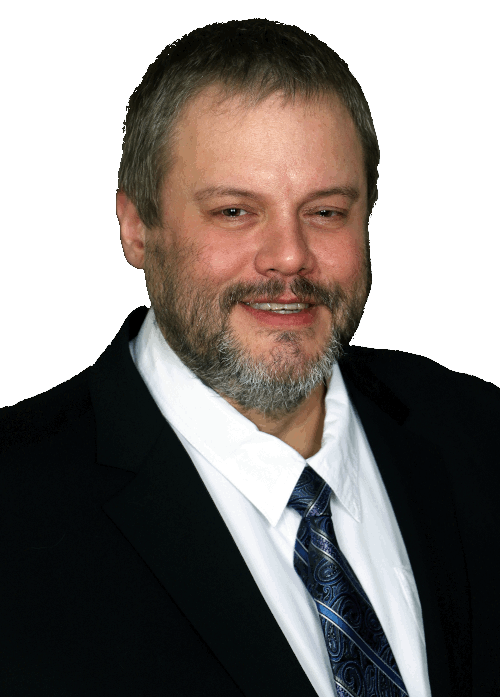
Dr. Loren Jay Chassels is a Board member of the New Jersey Libertarian Party. Loren earned his doctorate from A.T. Still University of Health Sciences, followed by an internal medicine residency in 2007. Now board-certified in internal medicine, he has practiced as a hospitalist and emergency physician for nearly two decades. See more at lorenjchassels.com |
For the last 12 years, my company, DR. CHASSELS, LTD.®, paid the health insurance premiums for my daughter and me. We had Blue Cross Blue Shield of Illinois because I thought it was the most trustworthy of the companies.
Last year, I retired and moved to New Jersey. Being a responsible patient (rare for a doctor), I arranged new-patient visits with a family-practice physician, a cardiologist, and a cardiac electrophysiologist to replace my doctors in Illinois. That expanded to a referral to gastroenterology for a screening colonoscopy. No problem. I’m doing the right things and being responsible.
After it was all performed, I started receiving the bills. The eight medications cost $30–60 each, as they have since my dilated cardiomyopathy diagnosis and three cardiac arrests. I paid full price for each physician visit and assumed it all went toward the $14,000 maximum out-of-pocket.
Then I saw the bill BCBS of Illinois rejected for being out of network: colonoscopy hospital services for $15,000. I was responsible for 100% of that charge. After a few months of phone calls, I switched to New Jersey Medicaid and Virtua ate the entire bill.
I’ve been haggling with insurance-company physicians for decades. Imagine if I were a normal patient trying to do the right thing!
This experience is not an anomaly. It is the predictable result of a system dominated by third-party payers—private insurers and government programs—rather than a free market in which patients control their own money and shop for care. As the Cato Institute has repeatedly documented, “The healthcare market is hindered in many ways, but the core structural problem is simple: The person receiving care is almost never the person actually paying for it. Roughly 90 cents of every dollar is covered by a third party—an insurer or the government.”
That arrangement “severs the give-and-take relationship between provider and customer that disciplines every other sector of the economy. When someone else pays, no one shops around, no one compares prices and no one asks whether a service is worth it… The result is predictable: opaque pricing, resistance to competition and no discipline to keep costs aligned with benefits.”
Cato scholars further note that America’s system “replaces consumer choice with government control and third-party payment” and is “effectively designed to make health care as expensive as possible.” Prices fall, quality improves, and medicine becomes more patient-friendly only when consumers take charge and exert pressure from below.
Empirical evidence confirms the theory. Research summarized by Cato shows that when patients become more price-sensitive, prices drop quickly and dramatically without reducing access: within two years, prices fell 10.5% for MRI scans, up to 32% for laboratory tests, and by an average of $10,505 (24%) for hip and knee replacements at high-priced hospitals.
In a genuine free market—where patients pay directly for most care the way they buy food, clothing, or cars—providers would compete on transparent prices and quality. Instead, third-party payment and government distortions produce the $15,000 “surprise” bills, the network traps, and the endless haggling that even a physician struggles to navigate. My colonoscopy bill is simply one more data point in a system that punishes responsibility and rewards opacity.